


















🌅 BACK TO THE SOURCE OF LIFE
Sabbath reflections for stillness, renewal, and an encounter with God
🌿 3. Series: Encounters with Jesus
💧 3.3 The Woman at Jacob’s Well
“If you knew the gift of God and who it is who says to you, ‘Give Me a drink,’ you would have asked Him, and He would have given you living water.”
(John 4:10)
🕊️ A Story – An Encounter in the Midday Heat
Jesus was traveling with His disciples from Judea to Galilee, and their journey took them through Samaria. This description of their route is significant because deep religious and social tensions had existed between Jews and Samaritans for centuries. Both groups appealed to the history of Israel and worshiped the God of their ancestors, yet different sanctuaries, religious traditions, and mutual prejudices divided them. Many Jews avoided close contact with Samaritans whenever possible, while the Samaritans also deeply distrusted the Jews.
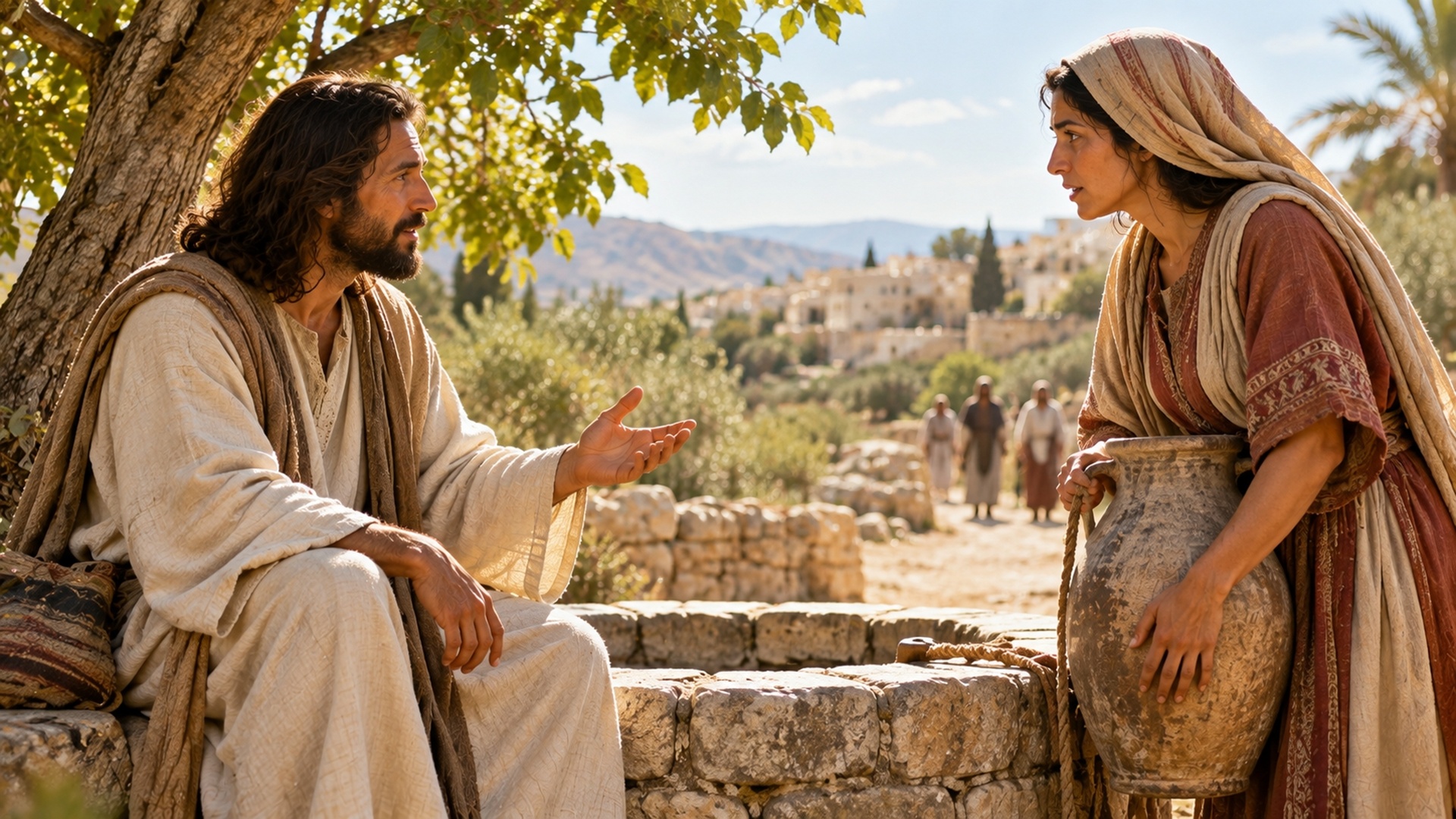
Jesus did not allow these boundaries to determine His actions. Around midday, He reached the vicinity of the Samaritan town of Sychar, where the ancient well of Jacob was located. The journey had exhausted Him, and John describes Him in a remarkably human situation: Jesus was weary from the long journey and sat down beside the well while His disciples went into the town to buy food.
It was about the sixth hour, during the heat of midday, when a Samaritan woman came to the well with her water jar. Water was usually drawn in the morning or evening, when the temperatures were more pleasant and several women could walk to the well together. John does not explicitly explain why this woman came alone during the hottest part of the day. Her later conversation with Jesus, however, reveals that her life story was complicated and that she may have experienced social rejection. Perhaps she had deliberately chosen a time when she was unlikely to meet other people.
When she reached the well, she probably expected nothing unusual. She intended to draw water and then return to the town. The Jewish man sitting there would probably pay as little attention to her as many others did. But before she could continue with her usual routine, Jesus spoke to her: “Give Me a drink.”
This simple request surprised her. A Jewish man was asking a Samaritan woman for water and was therefore willing to drink from her vessel. Jesus deliberately crossed a boundary that both societies had come to take for granted. Yet He did not begin the conversation by lecturing her about prejudice or condemning her way of life. He asked her for something she was able to give Him.
The woman responded with understandable amazement: “How is it that You, being a Jew, ask a drink from me, a Samaritan woman?” She knew the distance between their peoples and understood how unusual this encounter was. But Jesus immediately took the conversation beyond this boundary and said: “If you knew the gift of God and who it is who says to you, ‘Give Me a drink,’ you would have asked Him, and He would have given you living water” (John 4:10).
This completely transformed the situation. Only a moment earlier, Jesus had been the thirsty traveler asking for water. Now He explained to the woman that she was, in fact, the one who needed something from Him.
🌿 A Thirst That Reaches Deeper
At first, the woman understood Jesus’ words in a practical sense. A deep well lay before her, but Jesus had neither a vessel for drawing water nor a rope. She therefore asked where He intended to obtain this living water and whether He was greater than their ancestor Jacob, who had left them the well.
Jesus responded by distinguishing between two kinds of water: “Whoever drinks of this water will thirst again, but whoever drinks of the water that I shall give him will never thirst” (John 4:13–14). The water from Jacob’s well was necessary and good, but its effect was temporary. Anyone who drank from it today would have to return tomorrow. The water of which Jesus spoke, however, would become within that person “a fountain of water springing up into everlasting life.”
With this image, Jesus led the woman from her physical need to a deeper reality. Every person experiences needs that continually return. We need food, water, rest, and human closeness. Yet alongside these is a longing that outward things cannot satisfy. People want to be loved, accepted, and understood. They seek security, meaning, peace, and a hope that remains firm even when outward sources of security collapse.
Many things can conceal this inner thirst for a while. Success can create the impression that we are valuable. Possessions can promise security. Relationships can provide closeness, recognition can confirm that we are seen, and constant activity can prevent us from even noticing our inner emptiness. Yet all these things have limits. No human being can give another person everything their soul needs, and no outward achievement can replace fellowship with God.
At that moment, the woman at Jacob’s well did not yet understand how precisely Jesus’ words touched her own life story. At first, she heard only the promise of water after which she would never thirst again, and she replied: “Sir, give me this water, that I may not thirst, nor come here to draw” (John 4:15).
Perhaps she was still thinking about the daily effort of drawing water. Perhaps the prospect of no longer having to come to the well every day seemed especially appealing. But Jesus knew that her deepest thirst was not connected with the water jar. He therefore led the conversation toward a matter she probably had not expected.
🔥 When Jesus Touches the Truth of Our Lives
Jesus said to her: “Go, call your husband, and come here.” The woman answered briefly: “I have no husband.” Jesus replied: “You have well said, ‘I have no husband,’ for you have had five husbands, and the one whom you now have is not your husband; in that you spoke truly” (John 4:16–18).
Suddenly, the conversation was no longer about water, wells, or the differences between Jews and Samaritans. Jesus had addressed an area of her life that she herself had not mentioned.
The manner in which He did this is crucial. Jesus already knew about her past before the conversation began. When He asked her for water, He knew her entire life story. When He offered her living water, He knew about her former relationships and her present situation. Nothing that was now spoken was a disappointing discovery to Him.
This reveals the distinctive way in which Christ deals with guilt and broken life stories. He does not ignore the truth, but neither does He use it to humiliate people. He addresses what is hidden because healing can begin when a person no longer feels the need to flee from God.
We frequently tend toward one of two extremes. We either try to minimize guilt so that it will not burden us, or we allow it to define us so completely that we believe our past is our true identity. Jesus does neither. He names the truth while still seeing a person who does not have to be reduced to that truth.
The woman now realized that she was standing before a man who knew more than a stranger could have known. She said: “Sir, I perceive that You are a prophet.” Her understanding of Jesus began to change. At first, He had merely been a Jew to her. Then she had compared Him with Jacob. Now she recognized Him as a prophet. As in the story of the man born blind, understanding grows here one step at a time.
🌙 When Religious Questions Become Personal
After Jesus addressed her life story, the woman raised an ancient religious controversy. Her ancestors had worshiped on Mount Gerizim, while the Jews insisted that Jerusalem was the place God had appointed for worship. Perhaps this question was genuinely important to her. Perhaps it was also an attempt to move the conversation away from her personal life and toward a less painful theological subject. John does not explain her motive, but Jesus took her question seriously.
He explained that the decisive hour had come when the worship of God would no longer be determined by association with a particular geographical location. Then He said:
“But the hour is coming, and now is, when the true worshipers will worship the Father in spirit and truth; for the Father is seeking such to worship Him.”
(John 4:23)
With these words, Jesus brought the conversation back to the heart. True worship is more than a question of where a person stands. It concerns the reality of their relationship with God. A person may be in the right place and yet remain inwardly far from God. Conversely, someone who is socially excluded and carries a broken past can encounter God by opening their heart honestly to Him.
Worshiping “in spirit and truth” also means that we no longer need to play a role before God. We do not have to present Him with a carefully edited version of our lives. The woman at the well could not hide anything from Him anyway. Jesus already knew everything, and He still offered her living water.
This changes the meaning of honesty before God. We do not confess our guilt in order to inform Him about something He does not yet know. We open our hearts because we are allowed to stop hiding from the One who knows us completely and still seeks fellowship with us.
🌿 “I Who Speak to You Am He”
The conversation finally reached its climax when the woman said: “I know that Messiah is coming, who is called Christ. When He comes, He will tell us all things.” She was looking toward a future hope. One day, the Messiah would come, and the unanswered questions would be resolved.
Jesus replied:
“I who speak to you am He.”
(John 4:26)
The woman had seen a weary Jewish traveler beside the well. Now this man declared that the Messiah for whom she was waiting was sitting directly before her.
One of the most remarkable aspects of this story is the person to whom Jesus revealed His identity so clearly. He did not hold this extended conversation with a respected scribe in Jerusalem, but with a Samaritan woman beside a well. She belonged to a people rejected by many Jews, and her personal history hardly fit the image of someone whom others would expect to receive a special spiritual revelation.
But Jesus did not see the categories into which others might have placed her. He saw a receptive heart.
In The Desire of Ages, Ellen G. White describes the encounter at Jacob’s well as an impressive example of how Christ turns His attention to an individual and leads that person step by step into the truth. He began with an everyday need, awakened spiritual thirst, brought the hidden reality of her life into the light, and finally led the woman to recognize who He was. White also emphasizes that Jesus saw in this woman someone whose testimony would later reach many other Samaritans.
(See Ellen G. White, The Desire of Ages, chapter “At Jacob’s Well.”)
Only a few moments earlier, the woman had been thinking about how her daily journey to the well might become easier. Now she stood before a far greater discovery: the One for whom her soul had been searching had come to meet her.
It would soon become evident how deeply this encounter had changed her. The woman who had come to the well alone would run back into the town and seek out the very people she may previously have avoided. Her water jar would remain behind because something had become more important than the original purpose of her journey.
She had come to draw water.
She would return because she had found the Source.
“But whoever drinks of the water that I shall give him will never thirst.”
(John 4:14)
🕊️ The Water Jar Is Left Behind
At the moment when the conversation between Jesus and the Samaritan woman had reached its climax, the disciples returned from the town. They were astonished that Jesus was speaking with a woman, but none of them openly asked why. For the woman, something had now happened that pushed all social boundaries and even the original purpose of her journey to the well into the background. John reports a small detail that can easily be overlooked yet reveals much about her inner state: she left her water jar behind and returned to the town.
That jar had been the reason she came to the well in the first place. She had intended to complete an ordinary task and probably expected to return just as inconspicuously as she had arrived. Now the vessel remained behind because something else had become more urgent. The woman had not merely participated in an interesting religious conversation. She had met the man of whom she had just said that He would one day come and explain everything. Jesus had answered that this very Messiah was now speaking with her.
She therefore went to the people of Sychar and said: “Come, see a Man who told me all things that I ever did. Could this be the Christ?” (John 4:29). These words are remarkable. Jesus’ knowledge of her past, which must initially have been a painful moment in their conversation, had now become part of her testimony. She no longer had to pretend that this past did not exist. The man beside the well had known her completely and had still not turned away from her.
What may previously have been associated with shame now became evidence that she had encountered an extraordinary man. She did not declare, “I have finally found all the answers,” but invited others to come and see for themselves. Her understanding was still new, but her encounter was genuine. That was precisely what made her testimony credible.
🌿 When a Changed Heart Moves Others
The inhabitants of Sychar could have ignored the woman. They probably knew her better than any stranger did and may have known much about her life story. Yet something about her message, and perhaps also about her changed attitude, captured their attention. John reports that the people left the town and went out to Jesus.
An astonishing reversal becomes visible here. The woman who had come to the well alone became the person through whom an entire town became aware of Jesus. Her past did not disqualify her from speaking about what she had just experienced. Neither did she need to complete years of religious training before she could tell others about Christ. She did something very simple: she directed their attention away from herself and toward Jesus.
“Come and see.”
This invitation contains an important principle of Christian witness. We cannot force anyone to believe, nor can we answer every question another person might have. But we can draw people’s attention to Christ and invite them to know Him personally. Our testimony fulfills its purpose when people are no longer impressed by us, but begin to seek Jesus for themselves.
In her account of this event, Ellen G. White emphasizes how immediately the Samaritan woman became a messenger to others after her encounter with Christ. Although the disciples had spent much longer with Jesus, they initially failed to recognize the spiritual opportunities in Samaria. The woman, however, understood the value of what she had received and did not want to keep it to herself. Her personal experience became the starting point through which others also encountered Christ.
(See Ellen G. White, The Desire of Ages, chapter “At Jacob’s Well.”)
In this way, something of the image of living water was already being fulfilled. Christ’s gift does not stop with one individual. Those who receive from Him do not become a source independent of Christ, but become people through whose lives God’s grace can also reach others.
🔥 The Harvest the Disciples Could Not Yet See
While the woman was telling the people in the town about Jesus and they were making their way toward the well, the disciples were occupied with an entirely different matter. They had obtained food and urged Jesus to eat. But Jesus answered: “I have food to eat of which you do not know” (John 4:32). At first, the disciples understood Him just as literally as the woman had previously understood His words about living water. They wondered whether someone else had brought Him something to eat.
Jesus explained: “My food is to do the will of Him who sent Me, and to finish His work” (John 4:34). He then directed their attention toward the people approaching from Sychar and spoke about fields that were already ripe for harvest.
The disciples had entered a Samaritan town to purchase food. Jesus looked at the same town and saw people who were ready to hear the message of God’s kingdom. They had noticed the practical needs of the journey, while Christ also saw the spiritual longing of the people.
The story therefore returns to the theme of seeing. As in the account of the man born blind, Jesus showed His disciples that they needed to learn to perceive people differently. Prejudice can restrict our vision just as much as indifference. Those who have already decided which people are likely to show spiritual interest and which are not may overlook a harvest God has already prepared.
The Samaritan woman was the clearest example. Many people would probably not have expected her to lead others to Jesus within such a short time. But at the well, Christ had already seen what His disciples could not yet recognize: behind a complicated life story was a heart open to the truth.
🌙 From One Person’s Testimony to a Personal Encounter
The inhabitants of Sychar came to Jesus and asked Him to stay with them. He accepted their invitation and remained there for two days. This, too, was extraordinary for a Jewish teacher. Jesus did not merely hold a brief conversation with a Samaritan woman and then continue on His way. He accepted the hospitality of the Samaritans and spent time with them.
John reports that many more people believed because of His words. Finally, they said to the woman:
“Now we believe, not because of what you said, for we ourselves have heard Him and know that this is indeed the Christ, the Savior of the world.”
(John 4:42)
The woman’s testimony had now fulfilled its true purpose. The people did not continue believing merely because she had told them something, but because they had encountered Jesus themselves. Her words had opened the way, but Christ Himself became the foundation of their faith.
This development is also important for our own spiritual lives. Other people can tell us about Jesus. Parents can teach their children the faith, preachers can explain Scripture, friends can share their experiences, and spiritual writings can lead us to reflect. But eventually, the faith of which others speak must become a personal encounter with Christ.
The Samaritans could finally say: “We ourselves have heard Him.”
This is precisely where Jesus wants to lead every person. He does not want to remain merely the Christ of our parents, our church, or someone whose testimony impressed us. He wants us to recognize and receive Him personally.
🌾 The Sabbath – When Christ Satisfies Our Deepest Thirst
The encounter at Jacob’s well is especially appropriate for the beginning of the Sabbath because it addresses a question that can easily remain hidden amid the rush of everyday life: What is my heart truly thirsting for? During the week, we are so frequently occupied with immediate needs that our deeper longings are barely heard. Tasks must be completed, appointments kept, decisions made, and problems solved. Even when we become tired, we can continue functioning as long as the next obligation demands our attention.
The Sabbath interrupts this rhythm. Work ends, the pace slows, and space suddenly opens before us. At first, this rest may feel unfamiliar because it allows us to hear things we were able to conceal during the week. We may realize how exhausted we truly are, how deeply an unresolved conflict troubles us, or how dependent we have become on recognition, success, or control. In the stillness, something that appeared to be a practical problem during the week may reveal itself as a deeper thirst of the heart.
The Samaritan woman came to Jesus carrying a water jar. At first, she thought about the water she needed for her daily life. Christ took this practical need seriously, but He also led her deeper. He showed her that her life contained a thirst that neither water from Jacob’s well nor any human relationship could permanently satisfy.
We, too, bring our “water jars” into the Sabbath. Perhaps we come hoping simply to recover physically. Perhaps we look forward to rest, fellowship, worship, or time with our families. These are valuable gifts of the Sabbath. But Christ wants to lead us even deeper. He asks not only whether our bodies have come to rest, but whether our souls find rest in Him.
There is a difference between distraction and renewal. A person can stop working for twenty-four hours and still remain inwardly restless. Thoughts can continue working, worries can keep circling, and the heart may continue trying to drink from the same sources that failed to satisfy it during the week. The Sabbath becomes genuine spiritual rest only when we not only stop our activity, but also bring our neediness to Christ.
This is precisely why the image of living water corresponds so deeply with the Sabbath. On this day, we may recognize anew that our lives do not have to be sustained by what we ourselves produce. For six days, we work, create, organize, and bear responsibility. On the seventh day, we deliberately lay this work aside and remember that we are creatures. Ultimately, our lives are sustained not by our achievements, but by God.
Week after week, the Sabbath therefore tells us: You may receive.
We may read God’s Word without immediately turning it into another task. We may pray without needing to prove anything to God. We may remain in His presence because He Himself seeks fellowship with us. Jesus was already waiting beside Jacob’s well before the woman knew what would happen there. In the same way, our Sabbath encounter begins with a God who first comes to meet us.
Yet this story reveals a second dimension. Christ does not satisfy our thirst by avoiding the truth about our lives. The woman experienced acceptance and truth at the same time. Jesus spoke about her past, but He did so within a relationship in which she had already discovered that He did not despise her.
The Sabbath can also become such a space. When we become still in God’s presence, He may reveal things we have suppressed during the week. Perhaps He shows us a misplaced priority, a dependency, an unresolved conflict, or an area in which we repeatedly attempt to satisfy our deepest needs without Him. This realization does not contradict Sabbath rest. It can become part of its healing.
True rest does not arise from avoiding the truth. It grows from knowing that we may stand before God with the entire truth of our lives and still be loved.
This is precisely what the Samaritan woman experienced.
Jesus knew her story and remained with her.
He knew her guilt and continued speaking with her.
He knew her thirst and offered her water.
This is also the invitation of the Sabbath. We do not have to appear before God as the people we wish we were. We may come as the people we truly are. His presence is not a reward for a perfectly ordered life, but the source from which a renewed life can begin to grow.
What we receive, however, should not remain with us, just as it did not remain with the woman at the well. The Sabbath also directs our attention toward others. When our hearts have found rest in Christ, we can relate to people differently. We no longer need to expect them to confirm our worth or fill our inner emptiness. We can serve them, listen to them, forgive them, and speak about the hope we have found with greater freedom.
The movement of this story therefore continues through the Sabbath: we come to Christ thirsty, allow Him to know and renew us, and then return to the people around us. Yet we do not return as we came.
The woman left her water jar beside the well.
Perhaps there is also something we may leave with Jesus this Sabbath: a worry to which we have clung, a burden from the past week, the constant desire for recognition, or the attempt to control everything ourselves.
We do not have to carry the same jar home full every week.
In Christ, there is a fountain that never runs dry.
🤲 Invitation
During this Sabbath, take intentional time to ask God what your heart pursued during the past week. Which things demanded most of your attention, and what did you hope to receive from them? Perhaps they were good and necessary things that quietly began occupying a place they are unable to fill.
Bring this longing to Christ without disguising it. He already knows it. Ask Him to show you where you repeatedly return to wells that cannot satisfy your deepest thirst. Then remain in His presence, not merely to receive answers, but to experience Him anew as the Source of your life.
✨ Prayer
Lord Jesus, You saw the woman at Jacob’s well and knew what her heart was truly thirsting for even before she could understand Your words. You also know my deepest longings and how often I have tried to find in people, possessions, success, or my own control what only You can give me.
On this Sabbath, I want to come to You with my entire life. I do not need to hide anything from You because You already know my story. Lovingly show me where my heart seeks sources that repeatedly leave me thirsty, and give me the courage to release everything that keeps me from deeper fellowship with You.
Do not allow the rest of this Sabbath to be merely a pause from my work. Let it become a genuine renewal of my heart. Satisfy my restlessness with Your presence, my fear with Your peace, and my longing with Your love. Teach me not to continually live through my own strength, but to receive daily from the living water that only You can give.
When You have filled my heart anew, let Your grace reach others through my life as well. Give me the openness of the Samaritan woman, who did not keep her experience to herself but invited others to come to You. May my life not draw attention to me, but encourage people to come, hear You for themselves, and recognize that You truly are the Savior of the world.
Amen.
