











🌙 Still Awake?
One Step Closer to Jesus Every Evening.
📅 September 4
🏛️ When Faith Is Expected to Become Proof
📖 Matthew 4:5–6
“Then the devil took Him up into the holy city, set Him on the pinnacle of the temple, and said to Him, ‘If You are the Son of God, throw Yourself down. For it is written: “He shall give His angels charge over you,” and, “In their hands they shall bear you up, lest you dash your foot against a stone.”’”
Matthew 4:5–6
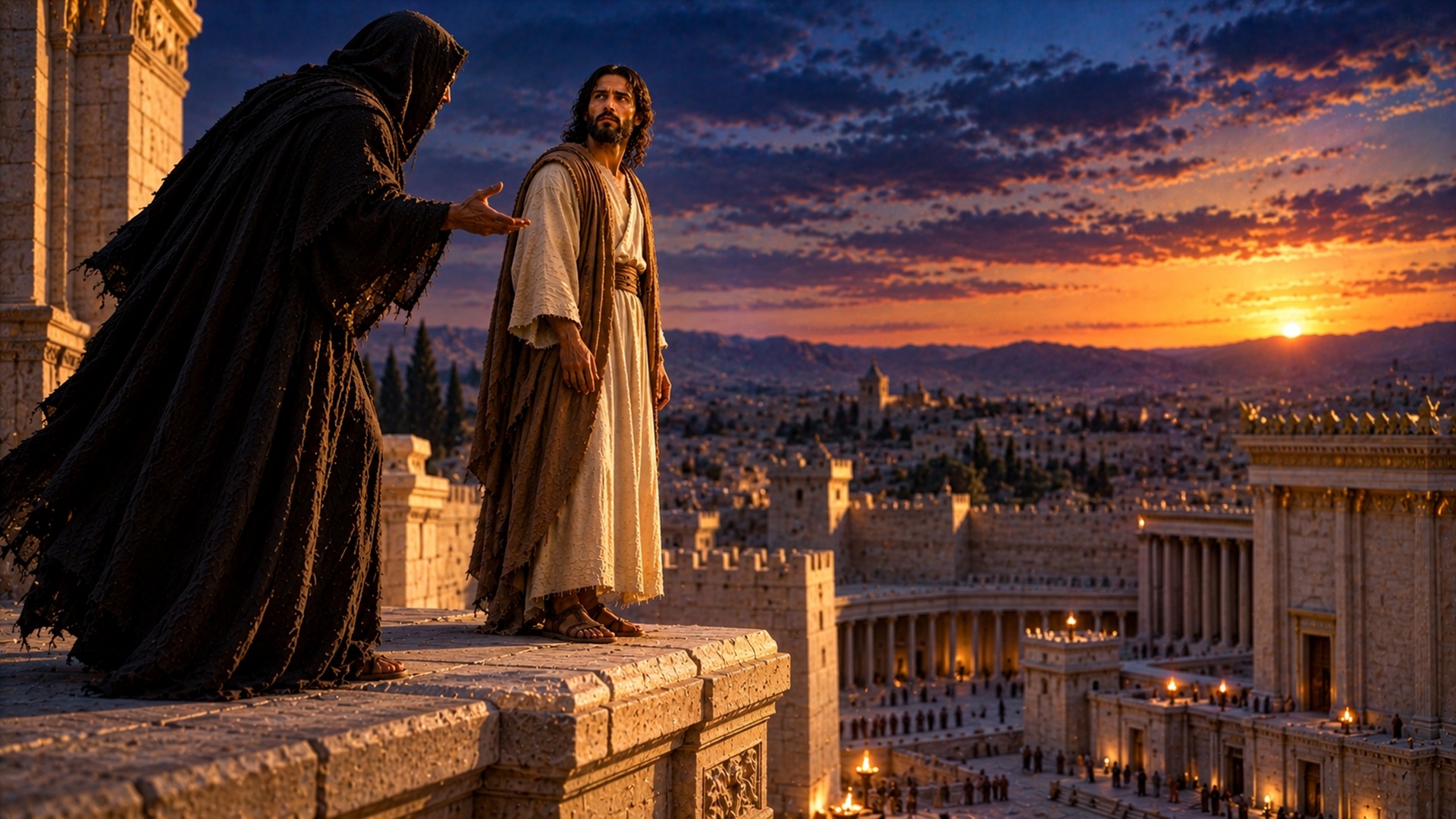
After Jesus had rejected the first temptation with God’s Word, the tempter changed his strategy. He took Jesus to Jerusalem and placed Him on a high point of the temple. Once again, the temptation began with the same words: “If You are the Son of God…” This time, however, it was not about hunger or bread, but about making Jesus prove His relationship with the Father through a spectacular act. He was supposed to throw Himself down and trust that God would miraculously rescue Him.
It is especially striking that the tempter now quoted the Bible himself. After Jesus had appealed to God’s Word, Satan also used a biblical passage, quoting from Psalm 91. This makes it clear that not every Bible quotation is automatically a correct application of Scripture. A verse can be quoted accurately and still be removed from its context in such a way that it supports something God never said. Jesus therefore needed not only to know what the Bible said, but also to understand what God’s Word truly meant.
📖 A Bible Verse Can Be Quoted Correctly and Still Be Misused
The tempter did not say something that was obviously godless. He even quoted a promise about God’s protection. Psalm 91 says that God commands His angels to protect His people. The promise was genuine, but Satan turned it into something the passage never intended. Trust was to become a reckless demonstration, and God’s protection was to become a reason for deliberately provoking danger.
This is an important lesson for the way we approach the Bible. It is not enough to know individual verses. We must learn to read them in context and ask what God actually intended to say. A single statement can sound very convincing, especially when it supports something we already want to do. We should therefore be careful when we search only for a verse that confirms a decision we have already made.
Sometimes people are not truly asking: “What does God’s Word say?” Instead, they are asking: “Can I find a verse somewhere that agrees with what I have already decided?” There is a great difference between these two questions. Those who genuinely want to hear God must also be willing to let Him correct them.
🏛️ The Temple Made the Temptation Appear Especially Religious
The second temptation took place at the temple itself, a place associated with God’s presence, worship, and the religious life of Israel. This made the temptation appear even more spiritual. Jesus was not being asked to perform some reckless act at an ordinary location, but precisely where many people could have witnessed His spectacular rescue.
Such a scene might have been impressive. Jesus jumps from the height of the temple, angels intervene, and a great crowd immediately recognizes that something extraordinary has happened. In this way, He could have gained attention without walking the long road of ministry, rejection, and ultimately the cross.
Yet this was precisely where the temptation lay. Jesus was not to reveal who He was through obedient service, but through a spectacular demonstration. He was to impress people instead of following the Father’s way.
Even religious activities can sometimes be shaped by the desire to make an impression. A person can speak about God while primarily seeking attention for themselves. Someone can want to appear spiritual so that others will admire them. Even prayer, biblical knowledge, or service in the church can be used to construct a particular image of oneself.
Jesus did not need a spectacular display to be the Son of God. His identity had already been confirmed by the Father.
🪞 You Do Not Have to Force God to Prove Something to You
The temptation indirectly demanded of Jesus: “If God truly is Your Father, He must prove it now.” Jesus was supposed to place Himself deliberately in danger and then expect God to intervene.
We can also adopt a similar attitude. Perhaps we think: “If God truly loves me, He must answer this prayer exactly as I want.” Or: “If He is really with me, this problem must not happen.” Sometimes we even establish inner conditions: “If God gives me this sign by tomorrow, then I will believe that He is leading me.”
Of course, we may ask God for clarity. Gideon asked for signs in the Old Testament, and God also guided people in extraordinary ways at times in the New Testament. Yet humbly asking God for guidance is different from imposing conditions upon Him and demanding that He fulfill our expectations.
Trust says: “I believe You even when I cannot see everything.” Putting God to the test says: “I will trust You only if You do exactly what I demand right now.”
Jesus chose trust.
🧗 God’s Protection Is Not an Invitation to Recklessness
Psalm 91 truly speaks about God’s protection. Yet this promise does not mean that we may deliberately expose ourselves to unnecessary danger and then expect God to rescue us. Those who trust in God’s protection do not act irresponsibly, but live wisely under His guidance.
This applies to very practical matters. A person cannot deliberately drive dangerously and then say: “God will protect me.” Someone cannot continually neglect their health and expect prayer to remove every consequence. Nor can anyone deliberately enter a situation that repeatedly causes them to fall and claim that God must protect them there from every temptation.
Trust and responsibility belong together. We may ask for God’s protection while also using the wisdom He has given us. We fasten our seat belts, make sensible decisions, establish boundaries, and avoid unnecessary risks without trusting God any less.
Faith is not an excuse for recklessness.
🎭 The Desire for a Spectacular Faith
Sometimes we may desire a life of faith filled with extraordinary experiences. We hear reports about remarkable answers to prayer, miracles, or impressive experiences and wonder why our own lives often appear so ordinary. We may then begin to think that strong faith must always be spectacular.
Yet Jesus rejected precisely this path. He did not need to throw Himself from the temple for His trust in the Father to be genuine. His relationship with God was revealed instead through His obedience, His decisions, His prayers, and later through His ministry to others.
Your faith does not have to appear spectacular to be genuine either. Perhaps your faithfulness tomorrow will consist of remaining honest even though no one is checking. Perhaps you will pray for someone without that person ever finding out. Perhaps you will decide not to continue an argument or will leave a temptation early.
Such steps may never be seen by many people, but they can be deeply valuable before God.
📱 When We Confuse Attention with Significance
Our world rewards visibility. Those who stand out receive attention, and those who receive attention quickly appear important. As a result, we can gradually develop the idea that something is truly valuable only when other people see it.
This attitude can also appear in our faith. Perhaps you want to tell others how much you read the Bible so that they will consider you especially serious. Perhaps you post spiritual content and feel disappointed when hardly anyone responds. Perhaps you feel less important in a church responsibility when no one explicitly mentions what you have done.
This does not mean that speaking about faith or publicly sharing something good is wrong. The decisive question concerns the heart: Why am I doing it?
At the temple, Jesus had a spectacular opportunity to gain attention. Yet He rejected it because the Father’s way mattered more than people’s reaction.
Sometimes you may also need the freedom to do something good without anyone noticing.
🧠 God’s Word Does Not Contradict Itself
Satan quoted Psalm 91, but Jesus answered with another passage of Scripture. In doing so, He showed that one verse must not be used against the Bible’s overall message. If an interpretation leads us toward something that clearly contradicts God’s will as revealed elsewhere, we must examine whether we have understood the verse correctly.
This is especially important because we could use individual verses to justify almost anything if we removed them far enough from their context. Sound biblical interpretation therefore considers the context: Who is speaking? To whom? In what situation? What comes before and after the passage? How does the text fit with what the Bible teaches as a whole about God and His will?
You do not have to be a theologian to do this. One simple habit already helps: Do not read only an isolated verse, but also the surrounding passage. Ask what the entire chapter is about, and compare difficult statements with other clear Bible passages.
In this way, you protect yourself from using God’s Word merely as a collection of convenient statements that support your own desires.
🧭 Faith Does Not Need Artificial Tests
Sometimes we test relationships by deliberately placing other people in situations where they are expected to prove their love for us. We may think: “If he really likes me, he will do this.” Or: “If she is truly my friend, she should know what I need without my telling her.” Such tests can burden relationships because hidden conditions replace trust.
Something similar can happen in our relationship with God. We establish conditions He never promised to fulfill and then become disappointed when He does not pass the test we invented.
Yet God does not have to pass our self-created test in order to be faithful. His faithfulness is revealed in His character, in His Word, and most clearly in Jesus.
If you do not understand today why a prayer was answered differently, you may feel sad or confused. You may honestly tell your loving Father that you had hoped for something else. But you do not have to conclude immediately that He loves you less because of it.
🛡️ Examine Thoughts That Sound Spiritual Too
Not every temptation sounds obviously evil. Some thoughts can even be expressed in very religious language. Perhaps you think: “God wants me to be happy, so this decision cannot be wrong.” Or: “If God has given me this opportunity, surely I must take it.”
Such statements may contain a grain of truth and still lead to a false conclusion. God desires what is best for us, but not every momentary pleasure leads to our good. An open opportunity is not automatically God’s calling. A powerful feeling is not automatically His guidance.
We therefore need several things together: God’s Word, prayer, clear thinking, and sometimes the counsel of mature Christians. When a decision is important, it can be helpful not to evaluate it solely according to our own feelings.
The Holy Spirit does not lead contrary to the Word He Himself has given.
🤲 Trust Does Not Need a Stage
Perhaps one of the most beautiful lessons of this temptation is that Jesus trusted the Father so completely that He needed no public proof. He could choose the unspectacular path because His relationship with the Father was secure.
We may also learn to live with this kind of assurance. You do not have to prove your faith constantly to other people. You do not have to make reckless decisions merely so that someone will call you courageous. Nor do you have to tell others about every spiritual experience in order for it to remain valuable to you.
Some of the deepest things between you and God may remain quiet. A prayer in your room can be just as genuine as a public prayer. A decision that no one sees can profoundly shape your character. Quiet faithfulness can carry more weight before God than an impressive appearance.
Jesus knew who He was without having to jump from the temple.
You, too, may know to whom you belong without constantly having to prove it.
❤️ God Protects—But According to His Wisdom
Despite Satan’s misuse of it, Psalm 91 remains a wonderful promise. God cares for His children, accompanies them, and can preserve them in remarkable ways. Yet His protection does not mean that we will never encounter anything difficult. Jesus Himself was later persecuted, beaten, and crucified, even though He was the beloved Son of the Father.
We must therefore not confuse God’s protection with a life free from suffering. Sometimes He visibly protects us from danger. Sometimes He leads us through a difficult experience and gives us strength we did not have before. At other times, we understand only much later how He acted.
Our hope does not rest in the belief that nothing difficult can ever happen to us. It rests in the assurance that nothing has to carry us beyond His presence.
This truth protects us from continually testing God. We may trust Him even when His care does not always look the way we expected.
🌱 A Quiet Faith Can Be Very Strong
Perhaps you are impressed by someone who speaks very openly and courageously about their faith. That can be something good. Yet strength is not revealed only in visible moments. It often grows through decisions that hardly anyone notices.
You refuse to join in when others ridicule someone. You remain honest during an examination. You put your phone away because you realize that something is drawing you in the wrong direction. You pray for someone even though you have been hurt. After making a mistake, you return to Jesus instead of continuing to hide.
None of these things would be spectacular enough to impress a large crowd. Nevertheless, genuine faith can grow precisely there.
Jesus rejected the spectacular shortcut at the temple. Later, He would show people who God is in a completely different way: through truth, compassion, service, and ultimately through the cross.
The gospel does not need a show to be powerful.
🌙 Before You Fall Asleep Tonight
Perhaps you have recently wished for a sign from God. Maybe you want to know whether He truly hears you or whether you are on the right path. You may honestly tell Him about this longing. At the same time, however, ask yourself whether you are imposing conditions upon Him that He never promised to fulfill.
Perhaps you expect: “If God is truly with me, this problem must disappear.” Or: “If He confirms my decision, everything must feel easy.” Such conditions can place an unnecessary burden upon our trust.
You may ask your loving Father for clarity without testing Him. You may ask for protection without deliberately acting recklessly. You may believe His promises without removing them from their context.
And if your faith looks completely unspectacular today, you do not need to be disappointed. Perhaps your faithfulness right now consists simply of continuing to walk with Jesus, taking His Word seriously, and making the right choice in one small decision.
That, too, is faith.
💭 Think about It
Have you ever placed conditions upon God in your heart and thought that He had to do something specific before you could trust His love or guidance? Also ask yourself whether you sometimes look for a Bible verse mainly because you want it to confirm a decision you already desire, and whether your faith depends too strongly upon experiencing something extraordinary or proving something before others.
🌟 Thought for Tomorrow
Tomorrow, when you find a spiritual-sounding reason for a decision, examine it a little longer. Read the relevant Bible verse in its context and ask: “Does my application truly agree with what God’s Word teaches as a whole, or am I using this passage merely to confirm my own desire?” If you are also waiting for a sign from God, bring that desire honestly before Him in prayer and ask for His guidance without prescribing the way in which He must answer.
🙏 Prayer
Dear Father,
Thank You that Jesus did not allow Himself to be persuaded at the temple to put Your love and protection to the test. Thank You that He trusted Your Word and did not need a spectacular demonstration to know that He was Your beloved Son.
Help me not merely to know isolated Bible verses, but to understand more fully what You truly want to say. Protect me from selecting or interpreting Your words in ways that simply confirm my own desires. Give me an open heart that is willing to be corrected by Your Word.
Forgive me when I impose conditions upon You and think that You must do something specific before I can trust You. I want to learn to believe You even when Your answer looks different from what I had hoped.
Give me wisdom not to confuse Your protection with recklessness. Help me act responsibly, establish healthy boundaries, and avoid unnecessary risks merely to prove something.
Also protect me from the desire to live out my faith for the attention of others. Let my relationship with You be genuine, even in the quiet decisions that no one sees.
Thank You that I do not need spectacular experiences in order to be known and loved by You. Help me tomorrow to trust Your Word and follow the path that is consistent with Jesus.
Amen.
🌙 Sleep well. Your loving Father does not have to prove His love to you through a test you have invented. You may trust His promises, live responsibly, and come one step closer to Jesus each day through a quiet and unspectacular faith. See you tomorrow.
